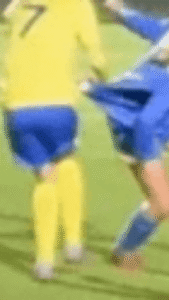
de speler in het geel maakt een overtreding tijdens het wedstrijd, door aan het shirtje te trekken van de tegenstander, shirtje trekken is een overtreding, je mag elkaar niet vast houden. Overtreding; shirtje trekken; vasthouden; voetbal; ballieballie; Voetbal; ballieballie; Voetbal; ballieballieVoetbal; ballieballie

Overtreding

Foul

There are various types of fouls, such as kicking an opponent, pulling, hitting,

spitting, swearing and other forms of misconduct.

This kind of behaviour has no place on the football pitch.

If the referee notices such behaviour, they can take disciplinary action, such as

showing a card, awarding a free kick or awarding a penalty.

Schwalbe

Diving

A dive is a form of simulation in which a player pretends that an opponent has

committed a foul, in the hope of winning a penalty or free kick.

Deceiving the referee in order to gain an unfair advantage often occurs in the

penalty area.

Nowadays, VAR can be used to review these situations. This makes it easier to

determine whether a genuine foul has taken place or whether the player has dived.

If a referee or VAR identifies a dive, the player should be shown a yellow card.

Although there is little Fair Play involved, diving is sometimes used as a tactical or

psychological tactic to frustrate the opponent or influence the match.

Hands

Handball

Handball occurs when an outfield player deliberately or unnaturally touches the ball

with their arm or hand.


It is a foul if a player deliberately touches the ball with their hand, or if their arm is in

an unnatural position, such as above the shoulder or held away from the body,

and the ball strikes it.

A goalkeeper can also be penalised for handball if they touch the ball with their

hands outside their own penalty area.

Gevaarlijkspel

Dangerous Play

Dangerous play occurs when a player attempts to play the ball in a way that risks

injuring another player or themselves.

A key characteristic is that there is often no physical contact. If contact does occur,

the offence is generally punished with a direct free kick.

Examples include raising a leg too high when challenging for the ball or

attempting to head the ball when it is too low.

Gevaarlijkspel

Dangerous Play

Dangerous play occurs when a player attempts to play the ball in a way that risks

injuring another player or themselves.

A key characteristic is that there is often no physical contact. If contact does occur,

the offence is generally punished with a direct free kick.

Examples include raising a leg too high when challenging for the ball or

attempting to head the ball when it is too low.

Buitenspel

Offside

Offside is a rule designed to prevent attacking players from simply staying close to

the opponent’s goal.

A player is offside if they are closer to the opponent’s goal line than both the ball

and the second-to-last opponent at the moment the ball is played by a teammate.

⚽️

There are, however, several exceptions to the offside rule.

If the player making the pass is beyond the last defender and you are behind the

ball, you are not offside. A player cannot be offside in their own half.


⚽️

A player who is in an offside position but does not touch the ball and does not

interfere with the goalkeeper is not penalised.

⚽️

You are not offside if you are behind the ball at the moment the pass is made.

⚽️

A player cannot be offside from a throw-in or corner kick.