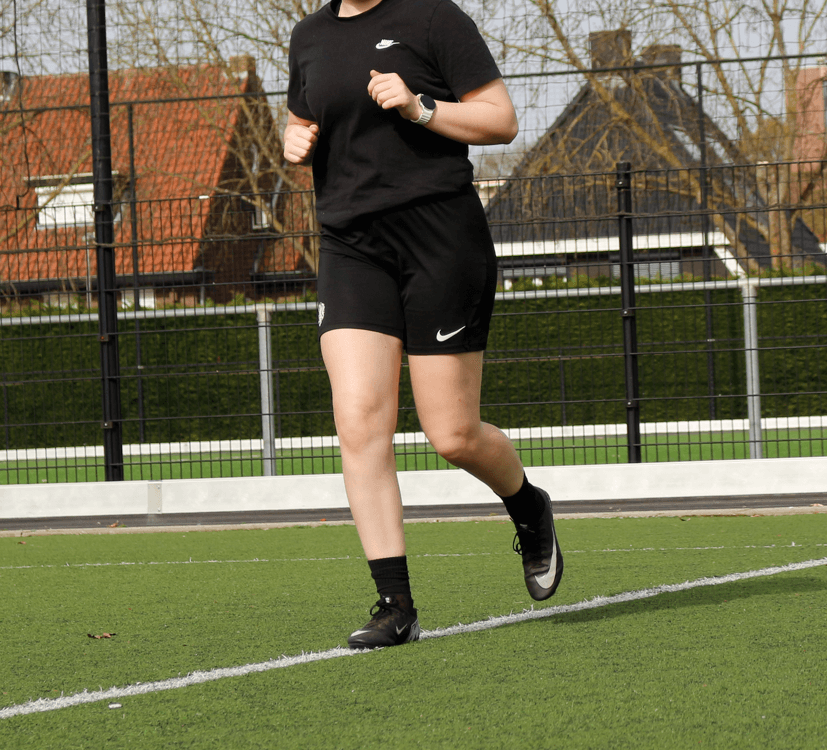
Een goede warming-up duurt minimaal 10 minuten. De warming-up verhoogt de lichaamstemperatuur en hartslag. Dit voorkomt blessures en verbetert prestaties door een betere doorbloeding van de spieren. Begin de warming-up met een lage intensiteit en voer dit geleidelijk op zoals joggen. warming-up; rennen, joggen; voetbal; ballieballie; Voetbal; ballieballie; Voetbal; ballieballie Voetbal; ballieballie

Rennen

Running

A good warm-up should last at least 10 minutes. A proper warm-up raises your body temperature and heart rate, helping to reduce the risk of injury and improve performance by increasing blood flow to the muscles. Start at a low intensity and gradually increase the pace, for example by progressing from walking to jogging.

Running

Running is an essential part of football, unless you are playing walking football.

⚽️

If you can run fast, you have a valuable asset on the football pitch — in this case, quite literally in your legs.

⚽️

There is nothing better than winning the ball back and being able to run at the opposition goal without the defenders being able to keep up with you.

⚽️

An average professional footballer covers approximately 10–12 kilometres during a 90-minute match.

⚽️

Midfielders are often the biggest distance-coverers, regularly covering 13–15 kilometres per match.

⚽️

Goalkeepers cover the least distance, averaging around 4–5 kilometres per match.

Hoe kan je sneller rennen.

How to Run Faster

There are several ways to improve your speed on the pitch, both with and without the ball.

⚽️

To improve your speed, it is important to develop your overall fitness and conditioning. This means training consistently to improve both your endurance and explosiveness.

⚽️

To become a faster runner, include interval training, lower-body and core strength training, and strides in your training routine.

⚽️

Gradually increase your training volume, focus on an active running posture with shorter, quicker steps, and make sure you allow enough time for rest and recovery.

⚽️

Alternate longer runs with short sprints. For example, run 900 metres at a steady pace followed by a 100-metre sprint, then repeat. This helps your body adapt to running at higher speeds.

⚽️

Exercises such as squats, lunges and core exercises help build stronger and more resilient muscles.

⚽️

After each training session, perform 5–6 short strides of 10–20 seconds. These help improve your running mechanics, posture and leg power.

Conditie opbouwen

Building Fitness

Build your fitness and endurance by training consistently 2–3 times per week. If you are starting out, begin with low-intensity activities such as walking, cycling or swimming.

⚽️

Gradually increase the intensity or duration of your sessions to reduce the risk of injury, and always allow enough time for recovery.

⚽️

Variety and a proper warm-up will help you get better results from your training.

Shuttle run test

Shuttle Run Test

The shuttle run test, also known as the beep test, is a progressive 20-metre interval test used to measure aerobic endurance.

⚽️

Efficient turning technique is crucial, because every turn causes you to lose speed and use additional energy.

The most effective way to turn is to slow down, stay low and push off quickly.

⚽️

Start turning your body just before reaching the line. This allows you to touch the line and accelerate immediately, rather than coming to a complete stop.

Take short, quick steps instead of long strides.

Avoid making wide turns. Instead, run straight back and forth between the lines.

⚽️

The test is demanding, but persistence is essential if you want to achieve a good score. Keep challenging yourself and try to be the last player standing.

Don’t give up!

⚽️

The shuttle run is also a useful exercise for developing explosiveness and agility, both of which are important in football.

⚽️

Scores are divided into levels. The higher the level you reach, the better your result.

  • Moderate: Level 6–7
  • Satisfactory: Level 7–10
  • Good: Level 10–11
  • Very good / Excellent: Level 11–13+

Explosiever worden

Becoming More Explosive

Become more explosive on the football pitch by combining plyometric training, lower-body and core strength training, and sprint intervals.

Focus on exercises such as box jumps, squats, lunges and speed-ladder drills to improve your acceleration, agility and reaction speed.

⚽️

Rest and recovery are essential to allow your muscles to adapt and become stronger.

Strides

Strides

Strides are short, controlled, explosive runs lasting approximately 15–30 seconds or covering 70–150 metres. They are performed at around 90–95% of your maximum speed, rather than at an all-out sprint.

Strides are used to improve running mechanics, acceleration and coordination, and are often included as part of a warm-up or performed after an endurance run.

Duurloop

Endurance Runs

An endurance run is designed to build your aerobic base and stamina, which are essential for staying fit and effective for the full 90 minutes.

Unlike long-distance endurance training, a steady 30–45-minute run is usually sufficient for football. Run at a pace that still allows you to hold a conversation.

As a basic conditioning session, repeat this twice a week. It can then be supplemented with interval training to replicate the changing intensity of a football match.

A football match requires both aerobic fitness and explosiveness.

Although a professional footballer may cover around 9–12 kilometres per match, steady running alone is often not enough, because football is an intermittent sport involving repeated periods of walking, jogging, running, sprinting and changes of direction.

⚽️

During the summer and winter breaks, include sprint interval sessions alongside your endurance runs.

For example:

30-metre sprint → 30 seconds recovery → repeat 10 times.

⚽️

It is advisable to alternate endurance runs with interval training so that you develop both stamina and explosiveness.

Whenever possible, perform running and sprint training on a softer surface to help reduce the risk of injury.