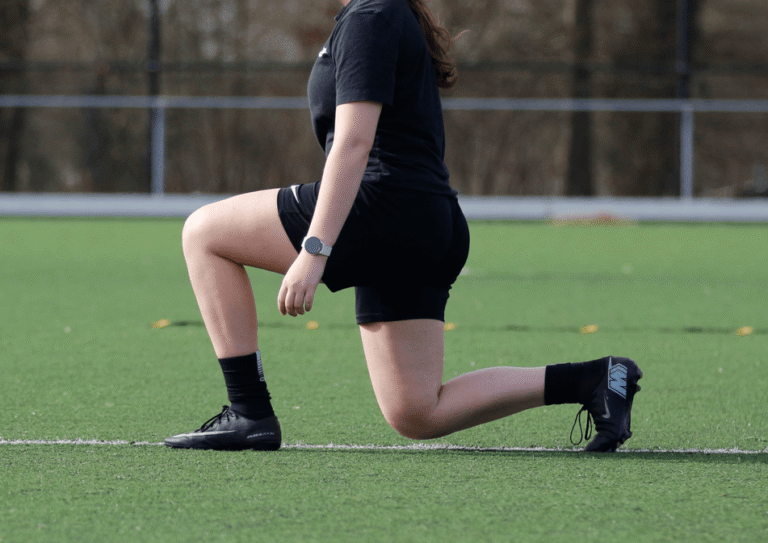
Warm-Up, Stretching and Cool-Down
Stretching is also commonly referred to as mobility or flexibility work.
Warming-up
Warm-Up
A good warm-up should last at least 10 minutes.
The warm-up gradually increases body temperature and heart rate. This prepares the body for physical activity, helps reduce the risk of injury, and can improve performance by increasing blood flow to the working muscles.
⚽️
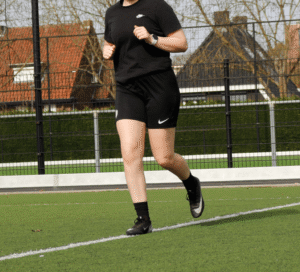
Start the warm-up at a low intensity and gradually increase the pace, for example by jogging.
A typical football warm-up should progress from general movement to more dynamic, football-specific movements before increasing to match intensity.
Suggested warm-up sequence
- Light jogging
- Dynamic mobility exercises
- Dynamic stretching
- Football-specific movements
- Gradual acceleration and changes of direction
Warming-up
Warm-Up
A good warm-up should last at least 10 minutes.
The warm-up gradually increases body temperature and heart rate. This prepares the body for physical activity, helps reduce the risk of injury, and can improve performance by increasing blood flow to the working muscles.
⚽️
Start the warm-up at a low intensity and gradually increase the pace, for example by jogging.
A typical football warm-up should progress from general movement to more dynamic, football-specific movements before increasing to match intensity.
Suggested warm-up sequence
- Light jogging
- Dynamic mobility exercises
- Dynamic stretching
- Football-specific movements
- Gradual acceleration and changes of direction
Dynamisch stretchen
Dynamic Stretching
Dynamic stretching involves moving through a controlled range of motion rather than holding a stretch in one position. It helps prepare the muscles and joints for the intense physical activity that follows.
After jogging, dynamic stretching should be incorporated into the warm-up.
⚽️
An active, dynamic warm-up prepares the muscles, tendons and joints for the demands of training or a match.
Dynamic Stretching Exercises
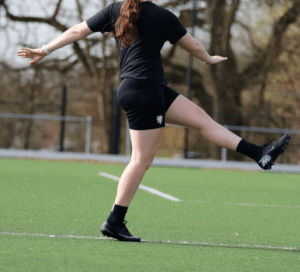
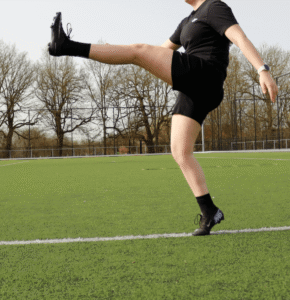
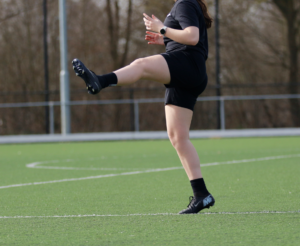
Leg Swings
Swing the leg forwards and backwards in a controlled manner. You can also swing the leg from side to side to mobilise the hips and hamstrings.
⚽️
Walking Lunges
Perform walking lunges while keeping your upper body upright. This helps warm up the quadriceps, hip flexors and groin muscles while also challenging balance and stability.
⚽️
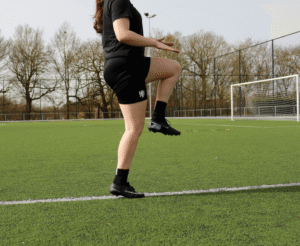
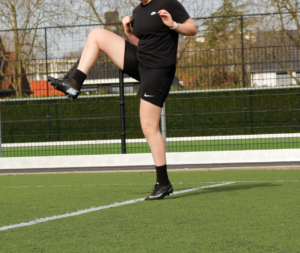
High Knees / Heel Flicks
Use a light jog to gradually raise the heart rate.
When performing high knees, lift the knee to approximately hip height while keeping the movement quick and controlled. Although this may initially feel exaggerated, practising a high knee action can help develop an efficient running technique and prepare the body for faster running.
⚽️
Hip Rotations / Hip Openers
While walking, bring one knee towards the chest and then rotate the knee outwards before placing the foot back down.
This dynamic movement helps mobilise the hips and hip flexors.
⚽️
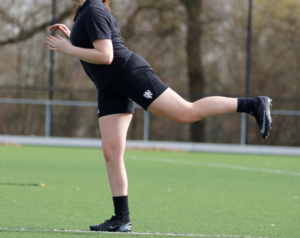
Inside-to-Outside / Outside-to-Inside Leg Swings
Swing the leg in a controlled movement from inside to outside or from outside to inside. This is a dynamic mobility exercise for the hips and groin.
⚽️
Crossover Leg Swings
Swing one leg across the body and then back outwards in a controlled movement. This dynamic exercise helps mobilise the hips and groin.
⚽️
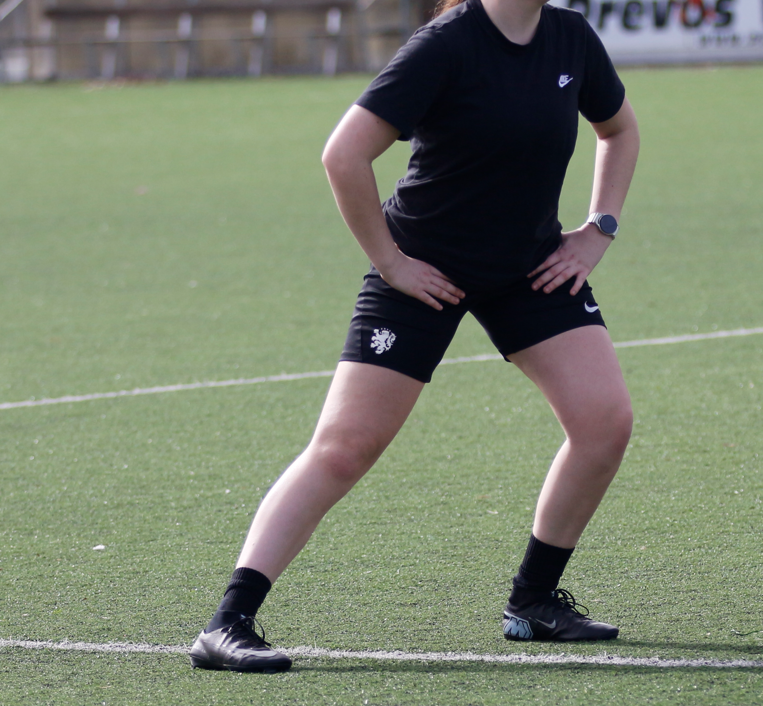
Side-to-Side Leg Swings
Swing the leg sideways across and away from the body in a controlled manner. This helps improve hip mobility and prepares the legs for changes of direction.
Cooling-down
Cool-Down
The cool-down begins with a light jog or walk.
A gradual cool-down after football training or a match can be useful for recovery. Continue at a low intensity for approximately 5–10 minutes, gradually bringing the heart rate down.
⚽️
After the cool-down, some light stretching can be performed.
Statisch stretchen
Static Stretching
After training or a match, static stretching can be incorporated into a recovery routine. Static stretching involves moving into a comfortable stretch and holding the position for approximately 20–30 seconds.
⚽️
Hamstring Stretch
Place one heel on a raised surface and gently lean forwards while keeping your back straight.
⚽️
Quadriceps Stretch
While standing, bring your heel towards your buttocks and hold it there. Keep your knees close together and maintain an upright posture.
⚽️
Groin Stretch
Sit on the floor with the soles of your feet together. Gently press your knees towards the floor using your elbows, without forcing the movement.
⚽️
Calf and Ankle Stretch
Keep your heel on the ground and gently lean forwards. Maintain a controlled stretch through the calf and ankle.
⚽️
Lower Back and Glute Stretch
Lie on your back and gently pull one knee towards your chest. Hold the position before changing sides.
⚽️
To encourage circulation in the legs, you can also lie on your back with your legs elevated against a wall. Hold this position for approximately 20 seconds and repeat as required.
Statisch stretchen
Static Stretching
After training or a match, static stretching can be incorporated into a recovery routine. Static stretching involves moving into a comfortable stretch and holding the position for approximately 20–30 seconds.
⚽️
Hamstring Stretch
Place one heel on a raised surface and gently lean forwards while keeping your back straight.
⚽️
Quadriceps Stretch
While standing, bring your heel towards your buttocks and hold it there. Keep your knees close together and maintain an upright posture.
⚽️
Groin Stretch
Sit on the floor with the soles of your feet together. Gently press your knees towards the floor using your elbows, without forcing the movement.
⚽️
Calf and Ankle Stretch
Keep your heel on the ground and gently lean forwards. Maintain a controlled stretch through the calf and ankle.
⚽️
Lower Back and Glute Stretch
Lie on your back and gently pull one knee towards your chest. Hold the position before changing sides.
⚽️
To encourage circulation in the legs, you can also lie on your back with your legs elevated against a wall. Hold this position for approximately 20 seconds and repeat as required.
Dynamic Stretching During the Warm-Up
Dynamic stretching is movement-based stretching. Instead of holding a position, the player moves actively through a controlled range of motion.
Exercises such as leg swings, lunges, hip openers and high knees can be used as part of a football-specific warm-up.
The aim is to prepare the body for the movements required during football, including running, accelerating, decelerating, changing direction and kicking.
Tips
Tips
- Avoid prolonged static stretching immediately before kick-off, as it may temporarily reduce muscle force and power.
- During dynamic stretching, prioritise functional movements that are relevant to football.
- Static stretching after exercise can be included as part of a recovery routine and may help the muscles relax.
- If your goal is to improve long-term flexibility, work on it consistently during recovery sessions and rest days, rather than relying solely on stretching immediately before training or a match.
- Maintaining good mobility and flexibility is important for football players, who regularly perform repeated movements involving the hips, hamstrings, quadriceps, groin and ankles.
- Stretching should always be controlled and comfortable. Never force a movement or stretch into pain.
Remember
Warm up dynamically before football. Cool down gradually afterwards. Use static stretching as part of your recovery and long-term mobility routine.
Tips
Vermijd statisch rekken voor de aftrap, dit kan de spierkracht tijdelijk verminderen.
⚽️
Maak bij dynamisch strechen, voornamelijk gebruik van functionele, voetbalgerelateerde bewegingen.
⚽️
Statisch rekken na de inspanning helpt bij het ontspannen van de spieren.
⚽️
Structureel leniger worden doe je op rustdagen, niet direct voor de wedstrijd of training.
⚽️
Maar is zeker niet onbelangrijk om zo lenig mogelijk te blijven omdat voetballers vaak korte spieren hebben door de kleine en korte bewegingen.