

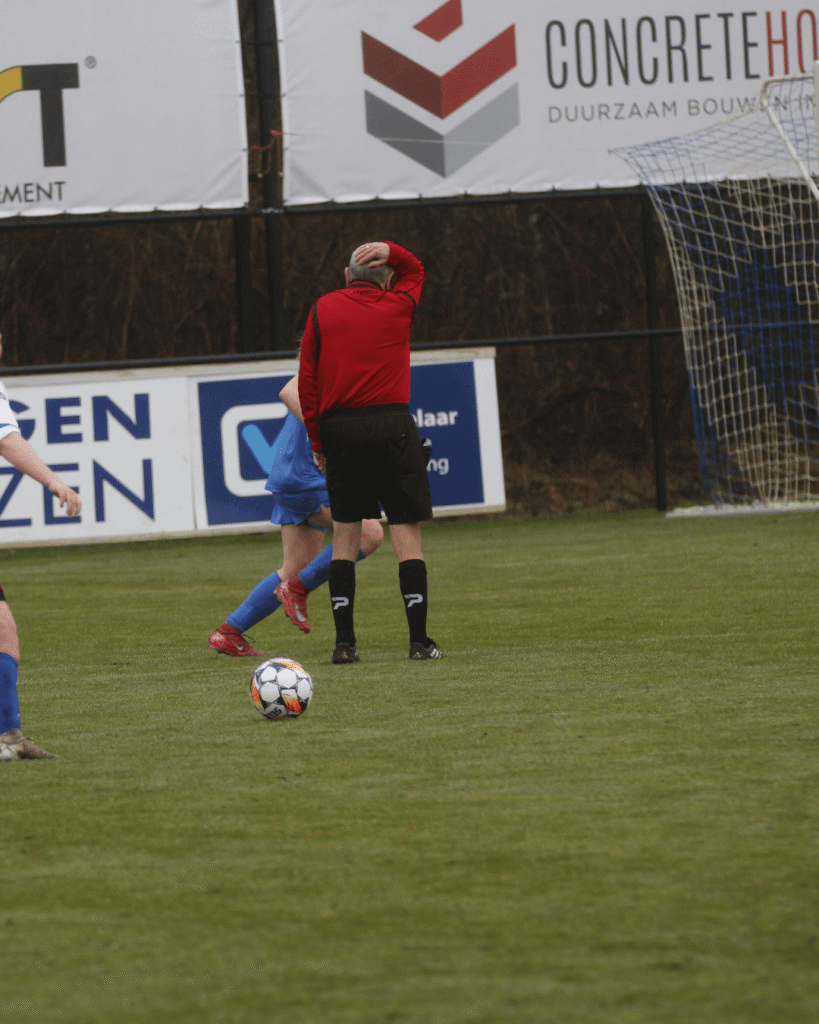
Scheidsrechter
The Referee
The game is officiated by the referee. In the Netherlands, the referee is assisted by assistant referees (often called linesmen at amateur level).
Assistant referees help the referee by indicating offside and certain fouls. They are also responsible for signalling when the ball has gone out of play over the touchline, and whether the restart is a corner kick or a goal kick. They also indicate which team should take the restart.
⚽️
Being a referee requires a good level of fitness. At professional level, referees can cover as much as 19 kilometres during a match.
⚽️
The referee is only human, and the game moves incredibly quickly.
Our attitude is simple: if you think you can do a better job, try refereeing a match yourself.
⚽️
We know there are also far too many “home-team referees” — referees who consistently make decisions in favour of the home team.
We don’t like that either.
And then there are assistant referees who deliberately flag for offside to favour their own team.
We understand the frustration. But once again: try standing on the touchline and doing the job yourself.
Sometimes, respect for referees is sadly lacking — both on the pitch and from the sidelines.
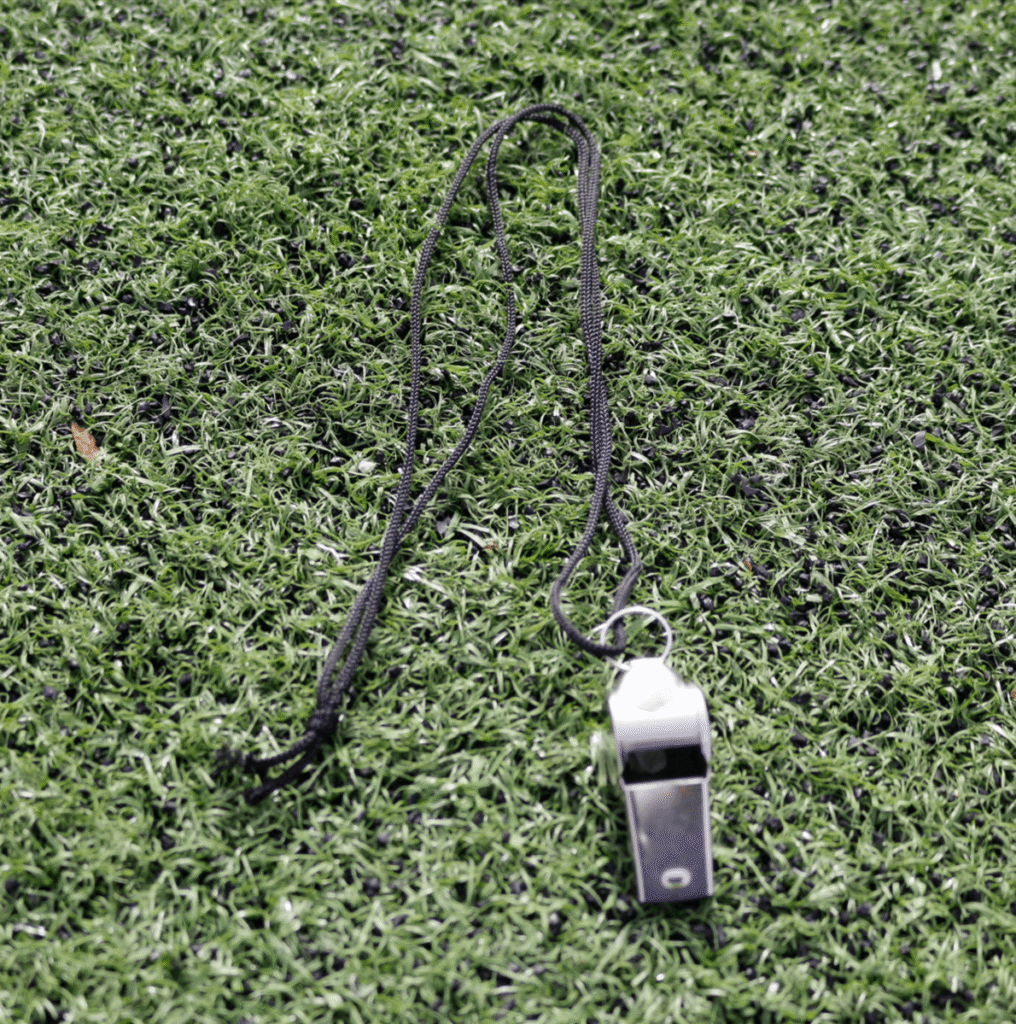
A whistle is an essential tool for clearly managing and directing a training session or match.
Respect voor de Scheidsrechters
Respect for Referees
Recently, we visited a football club that has come up with a great way to encourage young players to show more respect for referees. At the same time, the club is helping to address the shortage of referees.
⚽️
The youth players take turns refereeing matches involving the youngest teams at the club.
This gives them the opportunity to experience what it is like to be in the referee’s shoes.
As a result, they gain a better understanding of the referee’s role and are likely to develop greater respect for referees.
It also means that the youngest teams immediately have a referee for their matches.
⚽️
The club also offers young players the opportunity to take a referee course.
Every season, a number of teenagers sign up.
That is a fantastic development because these young referees are then trained and prepared to officiate matches at higher youth levels.

Gele en rode kaart.
Yellow and Red Cards
In football, yellow and red cards are disciplinary sanctions issued by the referee for certain offences.
A yellow card is a warning for misconduct or unsporting behaviour. If a player receives two yellow cards in the same match, the second yellow results in a red card.
⚽️
Receiving two yellow cards in one match, or a straight red card, results in the player being sent off and often leads to a suspension.
⚽️
A player can receive a yellow card for unsporting behaviour, dissent towards the referee, persistent fouling, delaying the restart of play, entering or leaving the field without permission, or failing to respect the required distance at a free kick.
⚽️
After receiving one yellow card, the player can remain on the pitch. In Dutch amateur football, however, accumulating five yellow cards results in a suspension.
From seven yellow cards onwards, each additional yellow card can result in another suspension.
A straight red card can be issued for serious foul play, violent conduct such as striking an opponent, kicking an opponent, or spitting, or for deliberately denying an obvious goal-scoring opportunity through a handball or foul. A player can also be sent off for using offensive, insulting or abusive language or gestures.
⚽️
Once a player has been shown a red card and has left the field, their team must continue with one player fewer. The player who has been sent off cannot be replaced.
⚽️
Fines
In Dutch amateur football, clubs can be charged fines for yellow and red cards. These generally range from around €15 to €35 per card, depending on the competition category and whether the player is a senior or youth player.
Gele en rode kaart.
Yellow and Red Cards
In football, yellow and red cards are disciplinary sanctions issued by the referee for certain offences.
A yellow card is a warning for misconduct or unsporting behaviour. If a player receives two yellow cards in the same match, the second yellow results in a red card.
⚽️
Receiving two yellow cards in one match, or a straight red card, results in the player being sent off and often leads to a suspension.
⚽️
A player can receive a yellow card for unsporting behaviour, dissent towards the referee, persistent fouling, delaying the restart of play, entering or leaving the field without permission, or failing to respect the required distance at a free kick.
⚽️
After receiving one yellow card, the player can remain on the pitch. In Dutch amateur football, however, accumulating five yellow cards results in a suspension.
From seven yellow cards onwards, each additional yellow card can result in another suspension.
A straight red card can be issued for serious foul play, violent conduct such as striking an opponent, kicking an opponent, or spitting, or for deliberately denying an obvious goal-scoring opportunity through a handball or foul. A player can also be sent off for using offensive, insulting or abusive language or gestures.
⚽️
Once a player has been shown a red card and has left the field, their team must continue with one player fewer. The player who has been sent off cannot be replaced.
⚽️
Fines
In Dutch amateur football, clubs can be charged fines for yellow and red cards. These generally range from around €15 to €35 per card, depending on the competition category and whether the player is a senior or youth player.
VAR
VAR
At professional level, there is also VAR — Video Assistant Referee.
VAR is a technology-based system designed to improve the accuracy of refereeing decisions. It is intended to support the referee, promote fairness and provide greater clarity in key match situations.
The VAR can only intervene in situations involving:
- Goals and offences leading up to a goal
- Penalty decisions and offences leading up to a penalty
- Direct red-card incidents
- Mistaken identity
The VAR team checks these situations to ensure that the Laws of the Game are correctly applied.
⚽️
The VAR checks every penalty decision to determine whether the penalty was correctly awarded.
For incidents involving a foul or handball, the VAR can recommend that the referee review the footage on the pitch-side monitor if there has been a clear and obvious error.
⚽️
During a penalty kick, the VAR also checks the goalkeeper’s position.
The VAR can intervene if the goalkeeper has both feet off the goal line when the ball is kicked and the goalkeeper saves or affects the outcome of the penalty.
If the penalty is missed or hits the post, the VAR will generally not intervene, unless the goalkeeper’s movement has had a direct impact on the kicker.
⚽️
The VAR also checks whether players enter the penalty area too early.
This only leads to intervention if the player has a direct impact on what happens next, for example by clearing the rebound.
Other situations, such as offside during the build-up to a penalty or whether a foul occurred inside or outside the penalty area, can be checked directly by the VAR team and communicated to the referee without the referee necessarily having to review the footage on the pitch-side monitor.